
In today’s digital ecosystem, immediacy is no longer a competitive advantage—it is a fundamental requirement. Users browsing a website expect instant, accurate, and personalized responses. For businesses operating on the world’s leading CMS, integrating AI Chatbots in WordPress represents a qualitative leap over legacy pre-programmed decision-tree systems. This technology not only turns customer service into an interactive 24/7 channel, but also dramatically optimizes conversion without compromising site speed.
From the perspective of web architecture and performance engineering at WebBitFlow, implementing conversational artificial intelligence must follow strict WPO (Web Performance Optimization) criteria. A chatbot should never be a bloated third-party script that ruins your Core Web Vitals metrics, but rather a lightweight, asynchronous, and highly efficient lead capture engine.
The 24/7 Customer Service Revolution with Artificial Intelligence
Traditional support systems rely on human resources limited to business hours or rigid scripts that frustrate users whenever a inquiry deviates from the plan. Modern virtual assistant plugins powered by Large Language Models (LLMs) process user intent using Natural Language Processing (NLP).
- Uninterrupted Availability: Precise real-time answers at 3:00 AM without extra operational costs.
- Contextual Understanding: Ability to interpret typos, idioms, and complex questions via RAG (Retrieval-Augmented Generation).
- Automatic Multi-Language Support: Instant detection of the visitor’s language to deliver tailored responses.
From Static Scripts to Conversational LLMs
The technical difference between traditional WordPress chatbots and advanced AI solutions lies in inference capability. While older plugins relied on regular expressions and static buttons, current tools connect via APIs to models like OpenAI GPT-4 or Claude. This allows training the chatbot on your company’s specific knowledge base, internal documentation, and product catalogs.
Enhancing User Experience (UX) and Visitor Retention
User experience (UX) is a critical factor in bounce rates and organic rankings. An AI-driven assistant acts as an interactive guide within your information architecture, reducing friction across the navigation journey.
When a visitor cannot locate a technical specification or pricing details on a site with hundreds of URLs, the virtual assistant can index and deliver the exact link in milliseconds. This immediacy prevents users from leaving your site to check competitors, thereby increasing dwell time and overall engagement.
Real-Time Lead Capture and CRO Funnel Integration
Conversion Rate Optimization (CRO) benefits directly from interactive chatbots. Instead of static, passive forms suffering high abandonment rates, data collection becomes a fluid conversation.
- Conversational Forms: Progressive collection of names, emails, and specific needs within the chat UI.
- Instant Segmentation: Prospect qualification based on expressed intent and user inputs.
- Webhook Synchronization: Instant delivery of captured lead data to CRMs like HubSpot, Salesforce, or ActiveCampaign.
Automatic Prospect Qualification
Not all website visitors carry the same commercial value. Implementing AI Chatbots in WordPress enables real-time qualification algorithms. For instance, if a user inquires about enterprise pricing, the bot can route them immediately to book a call via integrated calendars like Calendly, while routine FAQs are handled autonomously by the system.
The Performance Myth: Implementing AI without Harming WPO
There is a justified concern that adding chat plugins to WordPress will slow down performance due to heavy CSS/JS assets and constant HTTP polling. However, a modern engineering approach completely mitigates impact on Core Web Vitals metrics (such as LCP, FID, and INP).
Asynchronous Loading and External Webhooks
To guarantee web speed remains uncompromised, the architecture should adhere to the following technical principles:
- Serverless / Off-Site Execution: AI processing loads and vector database storage take place on external cloud infrastructure, not on your WordPress server.
- Widget Lazy Loading: The chatbot script does not execute during initial DOM rendering. It loads asynchronously after user interaction or via `requestIdleCallback` events.
- Minimized HTTP Requests: Utilization of WebSockets for continuous two-way communication instead of server-taxing polling loops.
Practical Use Cases and Direct Conversion Rate Impact
In e-commerce (WooCommerce), an AI chatbot acts as an automated personal shopper. It can recommend complementary products, resolve payment or shipping doubts, and recover abandoned carts by presenting targeted incentives right before the visitor exits.
For B2B service companies, these assistants shorten the sales cycle by overcoming technical objections instantly and scheduling sales demos directly onto your sales team’s calendar, yielding conversion rate increases of up to 35%.
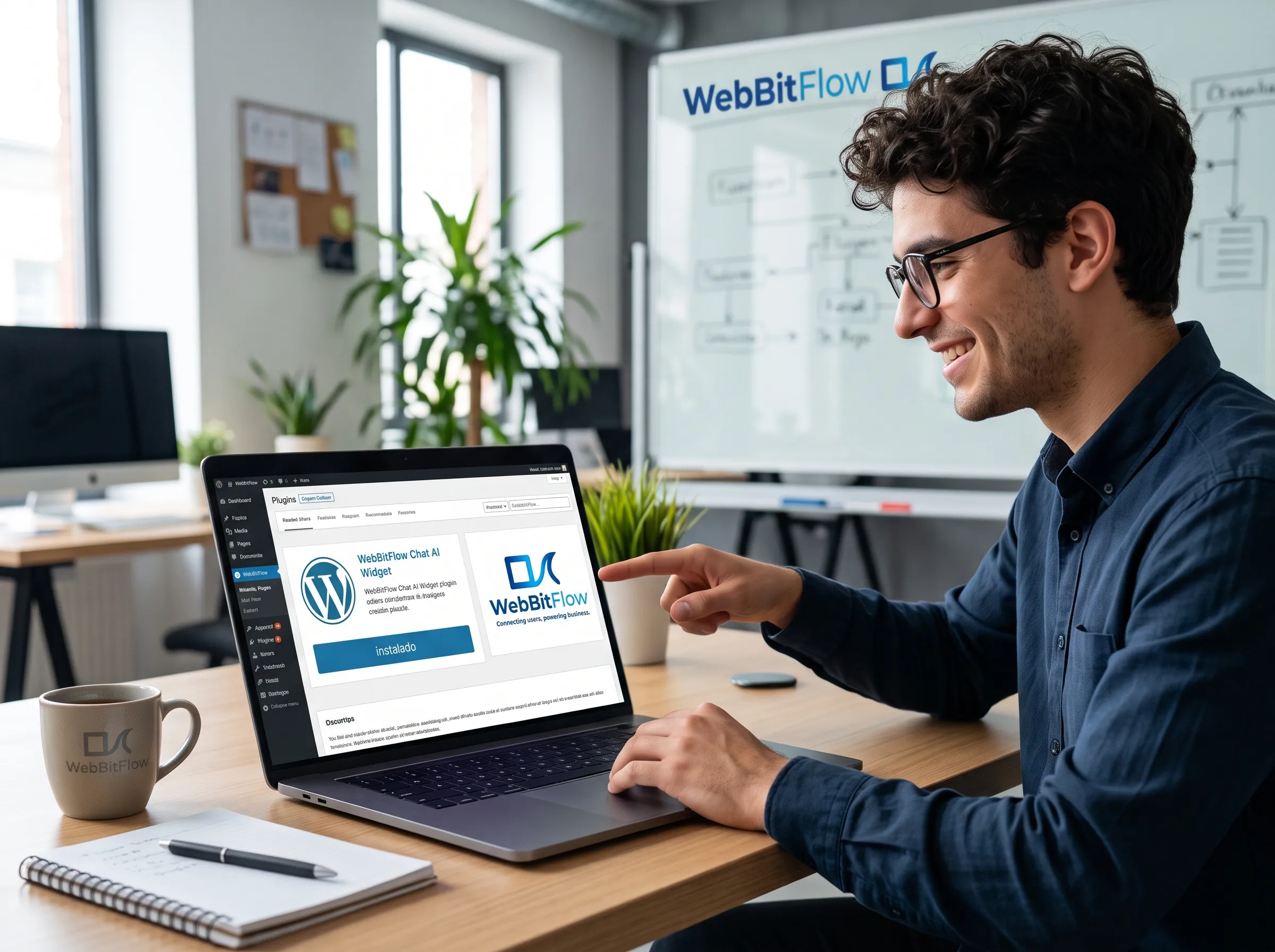
Do you want to implement AI Chatbots in WordPress efficiently, ensuring maximum speed and high conversions? As a showcase of our technical expertise, at WebBitFlow we have developed our own free plugin: WebBitFlow AI Chat Widget. You can download and test it directly from here, or watch the step-by-step installation and configuration tutorial on our YouTube channel. And if you are looking for a custom automation solution 100% tailored to your business, contact us today through our website or write to us directly via WhatsApp at +51 952 347 481 to boost your digital strategy.