
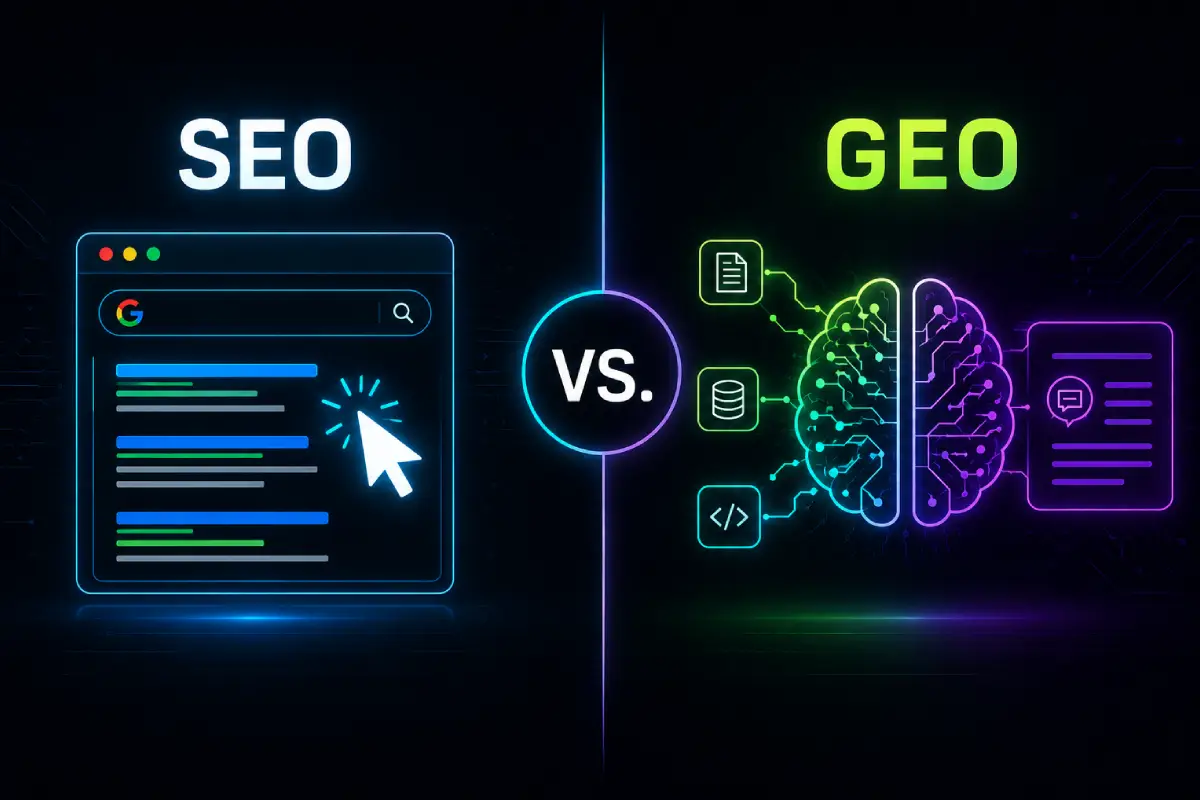
The digital marketing and web development ecosystem is undergoing its most profound transformation since the birth of search engines. For over two decades, the rules have been clear: optimize for Google, climb the ranks on Search Engine Result Pages (SERPs), and capture the user’s click.
However, the consolidation of Large Language Models (LLMs) and conversational assistants has given rise to a new paradigm: GEO (Generative Engine Optimization).
Does this mean traditional SEO is dead? Absolutely not. It means it has mutated. The key question for businesses is no longer “Can people find me on Google?”, but rather “Will Artificial Intelligence remember me when a client asks for a recommendation?”.
1. The Paradigm Shift: From Links to Language Models
The way users search for information on the internet has changed radically due to interaction with tools like ChatGPT, Gemini, or Perplexity:
- Natural and Longer Queries: The average traditional Google search used to be just 4 words. With AI, users formulate complex questions using natural language, raising the average to 23 words per query.
- Deeper Interactions: We have moved from the quick “one click and leave” search to conversational sessions that average 6 minutes of continuous interaction with the model.
- Consolidated “Zero-Click” Answers: AI processes web information and delivers a single, synthesized answer to the user. By resolving the query directly within the interface, the need to click on external links drops drastically.
2. SEO vs. GEO: Understanding the Structural Differences
To survive in this new environment, it is vital to understand that traditional SEO and GEO do not compete; instead, they target different objectives:
| Dimension | SEO (Search Engine Optimization) | GEO (Generative Engine Optimization) |
| Core Objective | Rank in the top positions of traditional search engines. | Get AI models to cite and recommend your brand. |
| Success Metric | Click-Through Rate (CTR) and organic traffic volume. | Citation rate and presence within AI responses. |
| Strategy | Keyword density, web architecture, and backlinks. | Advanced semantics, structured data, and high credibility. |
| Philosophy | The science of “Being found” by users. | The science of “Being remembered” by the AI. |
3. Why SEO is the Foundation of GEO
There is a myth that GEO will completely replace SEO. This is a severe technical misconception. Artificial Intelligences do not invent information out of thin air; they extract it from websites that already have excellent SEO.
- Technical SEO is the Wiring: If your WordPress site isn’t fast, secure (HTTPS), and cleanly structured, AI crawlers (like OpenAI’s GPTBot) won’t be able to read your content. If they can’t read you, you don’t exist for the model.
- AI Trusts Pre-existing Authority: Industry studies show that nearly 40% of the sources cited by AIs in their summaries come from pages that are already in Google’s traditional organic Top 10. Traditional SEO continues to build the reputation that AI demands before recommending you.
4. Practical Case Study: How Content Writing Changes
For a generative engine to choose your content over the competition, you must move away from “keyword stuffing” and focus on “data richness”.
The Obsolete Approach (Old SEO):
“If you are looking for quality web development, you are in the right place. We are the best web development company. We offer affordable, fast, and secure web development…”
The Modern Approach (GEO Optimized):
“Modern web development must prioritize performance. In our agency, we implement JAMstack architecture and development based on the MERN stack (MongoDB, Express, React, Node.js) for dynamic projects, guaranteeing server response times under 200ms.”
Analysis: The second text does not repeat empty keywords; it provides the AI with specific technology names (MERN stack, React), precise metrics (under 200ms), and cause-and-effect relationships that the model can easily extract and structure in its answers.
Conclusion: The Hybrid Strategy
The future of digital positioning belongs to those who know how to merge both disciplines. SEO ensures that your web infrastructure is visible to algorithms, while GEO ensures that your content contains the conceptual value, semantics, and hard data required to impact the cognitive layer of Artificial Intelligence.
If you want your business to remain relevant over the coming years, it is time to optimize your content for the new digital consumer: the human who asks, and the AI that answers.